My videos used to sit in the editing queue for weeks, waiting for me to find the money for an editor or the time to write a brief. Finding and working with editors is a whole story of its own: constant delays, poor edits or high fees. It can make content production feel like torture.
Now I shoot a video, send it to a Telegram bot and get back a finished video with a cover, description and subtitles. In this article, I explain how the system works, where it stumbled and which file makes the edits feel like me.
How it works
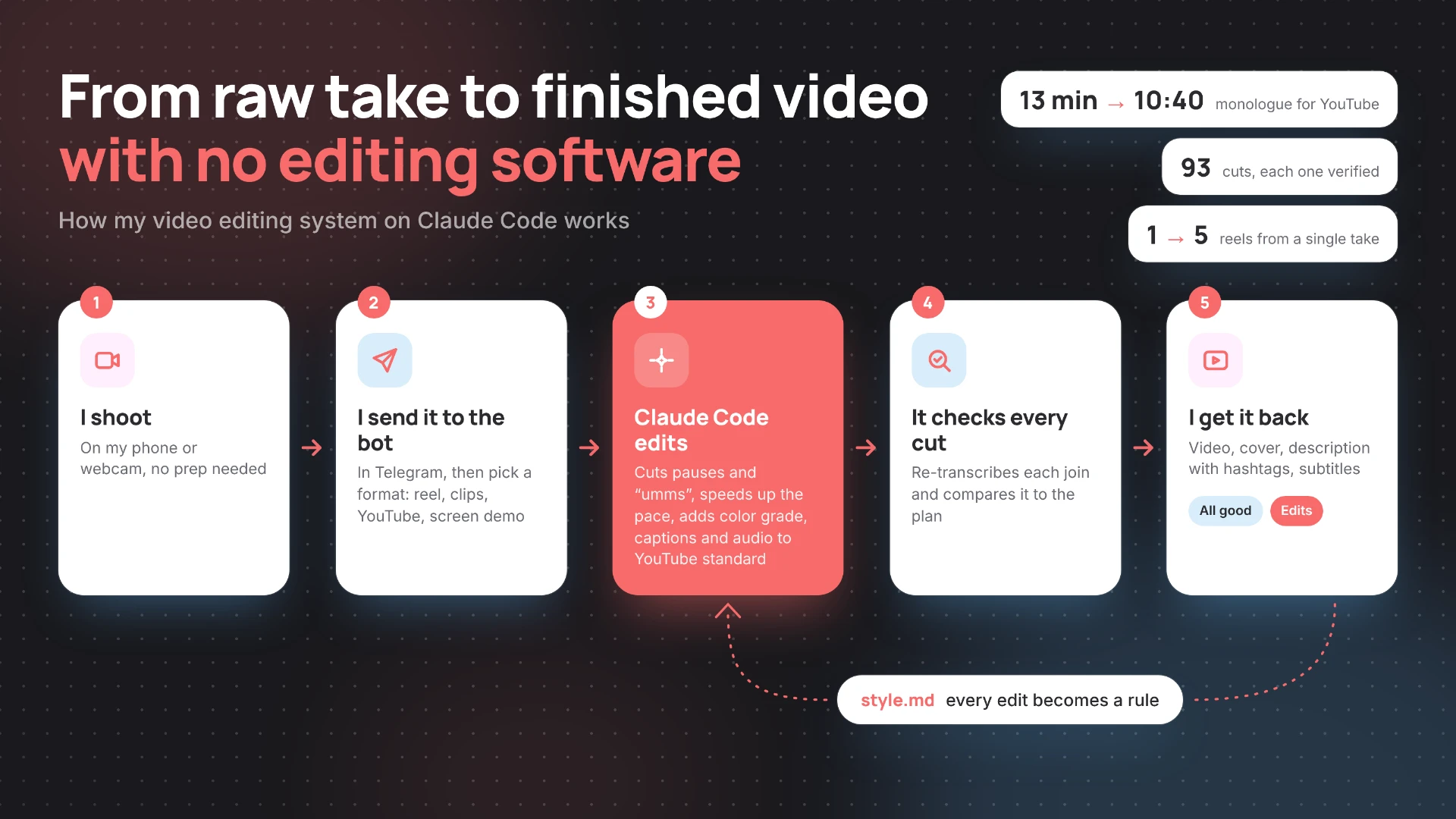
I record a video on my phone or webcam and send the file to a Telegram bot. Then I choose a format: • a vertical reel; • clips from a longer recording; • a YouTube video; • a screen demo.
After that, my Mac takes over. Claude Code assembles the video on it according to my rules, while I get on with other things.
What happens to the recording
The system transcribes speech down to individual words, then follows these steps: 1. Cuts pauses, verbal slips and “umms”. 2. Speeds up the pace. 3. Applies my color grade and captions. 4. Normalizes the audio to the YouTube standard.
Once everything is ready, the bot sends the video, cover, description with hashtags and a subtitle file. Underneath are two buttons: “All good” and “Edits”. If something is wrong, I describe the change in ordinary words, and the video is reworked. No timecodes or technical jargon.
What comes out
A thirteen-minute monologue became a 10:40 YouTube video. It contains 93 cuts, and the system checked every one itself. A single seven-minute take yielded five reels. Speed is not even the main thing here. I started filming more because I know editing will no longer be the bottleneck where videos get stuck for weeks.
AI cannot hear us — the most important thing I learned while building the editing system
One day I opened the finished shorts and heard the audio breaking up and jumping, even though every cut looked perfect on paper. It turned out that the webcam’s audio starts 0.22 seconds later than the picture. The system timed words against the audio but made cuts against the picture. So every cut chopped off the end of a word. A person hears this immediately, but the program does not notice at all.
There were other traps too: • Speech recognition does not transcribe “uh” and “mmm”, so they cannot be removed using text alone. We taught the system to find them in the audio: one video contained 18 hesitations, almost five seconds in total. • Quiet screen recordings caused words to be cut in half. The system now analyzes an amplified copy of the audio. • Sometimes I say one word 20 dB louder than the rest. The voice is now normalized word by word.
Never take a cut on trust
Those mistakes gave rise to the system’s main rule. After editing, it transcribes every join again and compares it with the plan. It finds a missing word before I do. Each such mistake is recorded as a rule, so the system does not stumble over it a second time.
The file that makes the edits mine
My editor has a file it reads before every video. It is called style.md, and it records everything that makes a video feel like mine.
We started with references
I collected eight videos I like, and Claude broke them down into techniques: the number of cuts, words per second, caption placement and how the hook works.
The rule from the start was to borrow the mechanics, not copy the look. No other people’s templates or stickers.
Then came my own decisions
• Captions appear one or two words at a time, in white. The emphasized word uses a light weight of the same font. We decided against color accents: lime, yellow, cream and pink clashed with my light hair and pink graphics. • It took four rounds to find the color grade, until skin looked alive and the image no longer had a yellow cast. • The hook can be read in one second with the sound off. • No shot stays on screen longer than five seconds. • The system writes music itself in code and sets it 27 dB below the voice. That way, I do not have to think about licenses.
Feedback does not get lost
When I dislike something, the change is added to style.md. With each video, the edits need fewer of my comments.
Get the system for yourself
I put this system together as an open package for Claude Code: scripts, instructions and all the traps we ran into. Take it and adapt it to your own style.
The package link is in my Telegram channel, @juliareactor. Follow along to see how I work on content automation.