AI does not build your skills. It works more like an exoskeleton. Nature Human Behaviour published a study worth reading if you are currently “learning AI”. It is called “Generative AI and the temporary upskilling of knowledge workers”. The authors include Emma Wiles, Lisa Krayer and a team including Francois Candelon.
This is not a survey or a case study. It is a randomised controlled experiment inside Boston Consulting Group, one of the most rigorous ways to establish evidence in research on work.
The researchers randomly assigned 986 BCG consultants to two groups. The final sample of participants who completed both tasks consisted of 487 people.
The AI group received a short, 15–20-minute introduction to prompting in GPT-4-powered ChatGPT and access to the tool. The control group received an equivalent introduction to Google, Stack Overflow and Khan Academy, but no ChatGPT.
Participants then tackled data science tasks outside their professional skill set. Consultants are not data scientists. Each participant received two of three tasks, with 90 minutes for each:
Python coding: clean, merge and filter datasets. Statistics: identify errors in an AI-generated analysis plan. Prediction: build a model to predict football match outcomes.
An important detail: the tasks were deliberately chosen so that ChatGPT could not solve them on its own. Participants could not simply paste in the instructions and get the answer.
The most useful benchmark came from 44 actual BCG data scientists who completed the same tasks without AI. Zero on the scale represents their average performance.
What happened
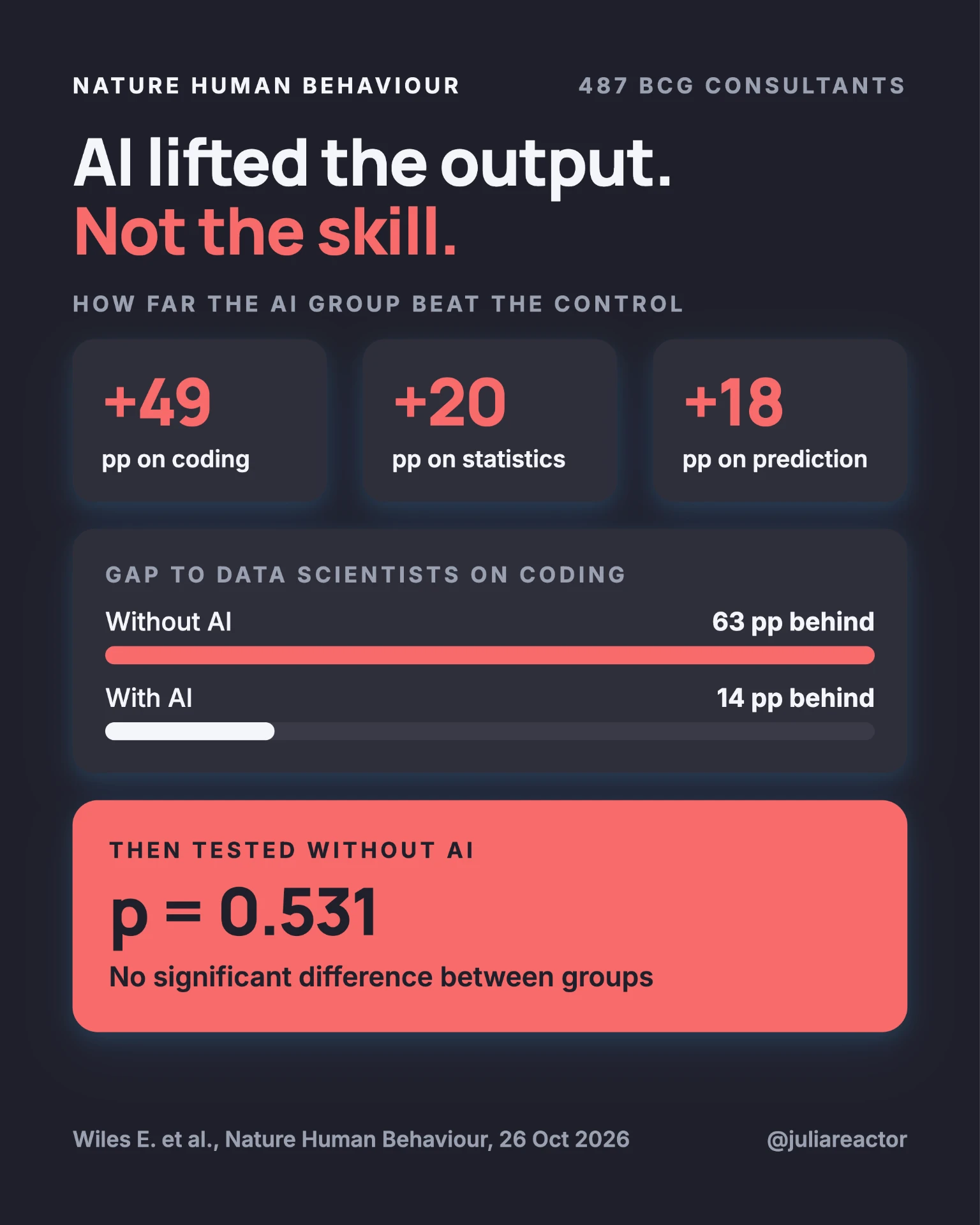
The AI group outperformed the control group by 49 percentage points on coding, 20 on statistics and 18 on prediction.
Consider the size of that 49-point difference. On coding, the control group scored 63 points below the data scientists. The AI group scored 14 points below them. People without the skill came close to specialist performance.
They were also faster: nine minutes less on coding and 14 minutes less on prediction, on average. More participants submitted their coding work, too: 167 in the AI group versus 133 in the control group.
The effect varied with prior experience. Participants who had at least some coding experience performed statistically indistinguishably from the data scientists on coding and statistics when using AI.
Now for the part that makes this study so interesting: after the experiment, everyone answered five technical questions without AI.
There was no detectable difference between the groups. The joint test yielded p = 0.531.
People produced near-expert work, but did not take away the knowledge that made that work possible. The authors call this temporary upskilling and distinguish two things we repeatedly conflate in conversations about AI:
The ability to complete a task with a new tool, which was supported by the evidence. The acquisition of knowledge that remains after the tool is removed, which was not.
That is the idea behind the exoskeleton metaphor. AI is not a training machine. Wearing it, you can lift a weight you could not lift alone. Take it off, and you are still the same person.
A third finding
The AI group became worse at predicting which tasks ChatGPT could and could not solve. They were more likely to believe the model could handle tasks it could not. The authors treat this as an ancillary finding, not a primary conclusion, but the direction is worth noting. The tool may expand your output while weakening your ability to recognise its limits. You do more while becoming less clear about where its capabilities end.
These were fragments of work, not an end-to-end project. Advanced methods such as deep learning were not tested. The sample consisted of highly educated consultants from a single company. Knowledge retention was measured shortly after the experiment, not six months later. Some grading was automated using GPT-4 Turbo, with human validation. The authors dropped one preregistered measure because of measurement problems. This is not a verdict against learning with AI. It is a reason to investigate further.
This matters to all of us. Replace data science with whatever you currently use AI for: writing in a language you do not speak well, analytics you are not confident in, strategy in an unfamiliar niche, design or code for a landing page. You get the result, but not necessarily the skill. As long as the tool is available, the difference can be invisible. What happens when it is not?
Three takeaways for my own work
Borrowed competence is fine, but make the choice consciously. Write down what you want to develop as your own skill and what you are happy to keep borrowing from the model.
Your existing foundation multiplies the effect. In the study, people with at least some experience did better. If you understand your field, AI can take you to a level you could not previously reach. If you do not, it can take you to a level that merely looks convincing.
Knowledge needs to live in the system, not just in someone’s head. If a skill does not stay with the person, preserve it in the workflow: prompts with explicit criteria, verification checklists, mandatory human review points and documented definitions of success. Then competence will not disappear with the session. It becomes an asset of the process.
I am continuing to explore this for myself and my clients. If you want to turn your AI tasks into a system that maintains quality without your constant involvement, join me on Telegram: @juliareactor. I will share what I find in real workflows.